If you want to invest more thoughtfully, the hardest problem is rarely finding another stock idea. It is deciding what deserves research, what evidence would change your mind, and how much risk you can actually carry. Investor interviews can inspire you—but they can also tempt you to copy a portfolio without understanding the reasoning.
The Value Investors: Lessons from the World’s Top Fund Managers by Ronald Chan is useful as a comparison exercise. It profiles value investors and considers how they approach research, valuation, temperament, risk, and capital allocation. The book is not a current stock list, a guarantee of returns, or a substitute for checking today’s filings and facts.
The practical answer: use the book as a map of questions, not a set of personalities to imitate. Compare each investor’s process on five dimensions: what they buy, why they think it is mispriced, what could go wrong, how they size risk, and what would make them sell. Then write your own decision rule before committing money.
This article offers seven Wealthy I AM–synthesized lessons inspired by the book’s subject matter. The numbered structure is editorial synthesis, not a claim that Chan presents these exact seven lessons as a formal list.
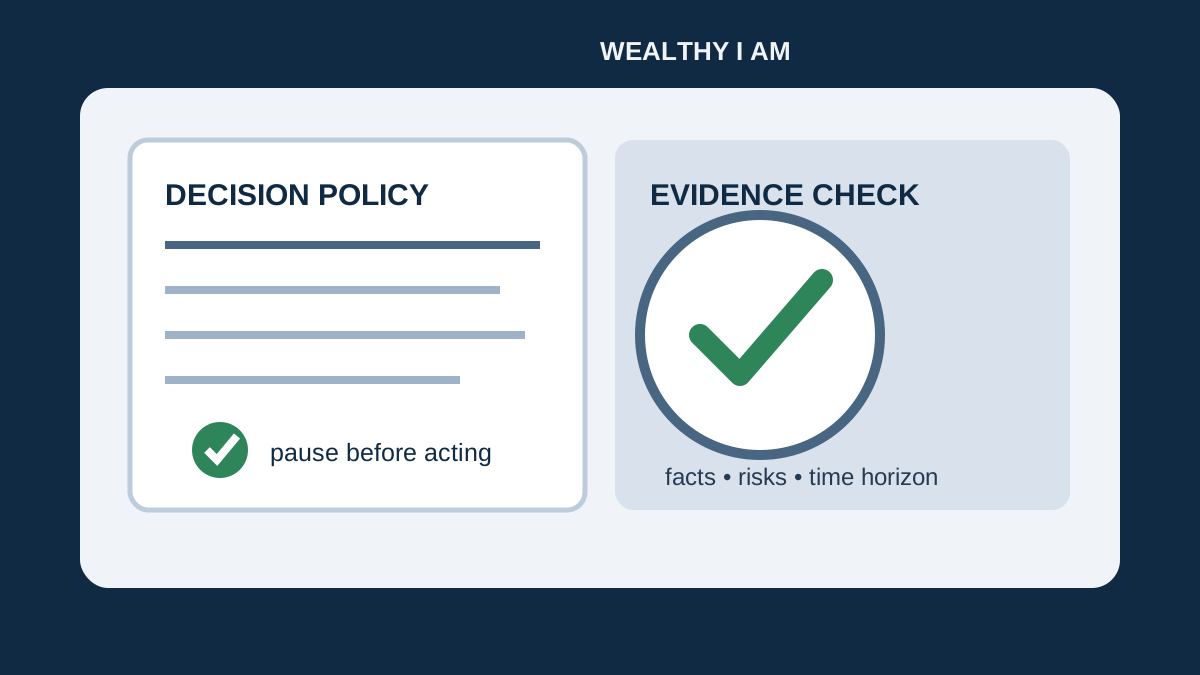
Image: original Wealthy I AM illustration showing a written investment policy, evidence check, and long-term values.
Who this book is for—and what it cannot prove
The book may suit readers who want to understand how experienced investors describe research, valuation, patience, and downside protection. It can broaden your vocabulary and expose you to different approaches. But an interview is not proof that a method works in every market. Results may reflect a particular period, opportunity set, team, mandate, costs, tax situation, or luck.
Keep three layers separate: the book’s reported philosophies; current evidence from company reports, regulatory filings, and fund documents; and your own application, which must fit your goals, time horizon, and ability to tolerate loss. This is general education, not individualized financial advice. Investments can lose value, and diversification can reduce concentration risk without eliminating market loss.
1. Study the process, not the personality
A famous investor can make a method look simpler than it is. The transferable lesson is not “buy what this person buys.” Ask what the investor does before, during, and after a decision.
Turn every profile into a process map
For each investor, note the research question, valuation approach, holding-period assumption, risk control, and exit condition. If a profile does not provide enough detail, record the gap rather than filling it with assumptions.
Try this: summarize one process in five neutral verbs: screen, investigate, value, size, review. Compare that sequence with your own. The goal is a better checklist, not a borrowed identity.
2. Define value before you search for it
Value investing generally means looking for a gap between what an asset appears worth and what the market currently asks for it. That gap is uncertain: estimates depend on assumptions about cash flows, competition, balance-sheet strength, management, and the future.
A margin of safety is a deliberate cushion between your estimate and the price you would be willing to pay. It is not a promise that the estimate is correct or that a loss cannot occur.
Before opening a stock screen, write one sentence defining value for the situation. Is your focus durable cash generation, asset backing, a temporary earnings problem, or another test? Without a definition, “cheap” can become a label attached to whatever catches your attention.
3. Compare evidence quality, not just conclusions
Two investors can reach the same conclusion for different reasons. One may test competitive threats and cash conversion; another may rely mainly on a low valuation multiple. The conclusion alone does not show whether the reasoning is robust.
Use an evidence ladder:
- Primary evidence: audited reports, regulatory filings, and company disclosures.
- Independent context: credible industry, competitor, or market information.
- Interpretation: your explanation of what those facts might mean.
- Prediction: a claim about what will happen next.
Keep interpretation and prediction separate. A historical record can inform a thesis; it cannot make a forecast certain. When an investor profile uses an older example, ask which facts remain current.
4. Treat temperament as a risk control—not a magic trait
Patience, independence, and the ability to withstand disagreement can matter because markets may move before a thesis is resolved. Yet “be patient” is incomplete if the analysis was wrong or the money is needed soon.
A practical patience rule needs conditions: time horizon, thesis checkpoints, liquidity needs, and a reason to exit. Liquidity means how easily an investment can be converted to cash without a large price concession. Someone with a short time horizon may need more accessible assets than a long-term investor.
Try this: write two lists before buying: evidence supporting the thesis and evidence that would invalidate it. Patience is staying with a sound process, not refusing to update.
5. Make downside analysis concrete
Downside analysis asks what could impair the business or investment: weaker demand, debt pressure, competition, poor capital allocation, dilution, regulation, or an optimistic valuation.
Avoid false precision. Write three qualitative cases—more favorable, middle, and less favorable—and list the key assumption in each. Ask whether the investment would still be acceptable if the less favorable case occurred. This is a research discipline, not a forecast; it exposes concentration and assumption risk before money is committed.
6. Put capital allocation in the business analysis
A company can produce accounting profits and still make poor decisions about cash. Capital allocation includes reinvestment, acquisitions, debt reduction, dividends, share repurchases, or holding cash.
Ask whether management has a coherent reason for its choice and whether it fits the business’s opportunities and balance sheet. Past decisions provide evidence but do not guarantee future judgment.
Research step: create a short capital-allocation timeline from primary reports. Record the stated purpose, what changed afterward, and what remains uncertain. Do not declare success from a price move alone; business results and market prices are related but not identical.
7. Build a decision policy you can follow
Convert reading into a repeatable policy that reduces impulse without pretending uncertainty can be removed. Before researching a candidate, answer:
- What is the business, in plain language?
- What facts support the idea that it may be mispriced?
- Which assumptions matter most?
- What could permanently impair the thesis?
- What position size and time horizon would keep one mistake survivable?
- What evidence would make me do nothing or change my mind?
“No action” is valid when evidence is incomplete, the price offers too little cushion, or the position would make the portfolio too concentrated. A checklist is valuable because it can stop a compelling story from becoming an impulsive decision.
A 30-minute research exercise
Choose one company only as a hypothetical research subject; this is not a recommendation. Produce a one-page note with a plain-language business description, three to five value drivers, the strongest supporting and challenging facts, key assumptions, risks you cannot yet assess, the condition that would change your mind, and a decision: research further, wait, or do nothing.
Do not add a current price or return estimate unless you have separately verified a dated source and can explain the uncertainty. The useful output is a clearer record of what you know, what you do not know, and what you would check next.
Mistakes to avoid
- Copying holdings: context, timing, mandate, and risk capacity may differ.
- Confusing a low multiple with low risk: a cheap metric can reflect deteriorating economics or debt.
- Using patience to defend a broken thesis: define review and exit conditions.
- Overfitting one success story: a case illustrates a possibility, not a universal rule.
- Ignoring implementation costs: fees, taxes, bid-ask spreads, liquidity, and concentration can affect results.
- Treating a checklist as certainty: a disciplined process can still be wrong.
Frequently asked questions
Is The Value Investors beginner-friendly?
It can introduce different value-investing perspectives, especially when read as case studies. Beginners should pair it with basic explanations of financial statements, diversification, valuation uncertainty, and risk.
Should I invest like the people profiled?
No automatic conclusion follows from a profile. Use interviews to generate questions, then verify current evidence and decide whether an approach fits your objectives and constraints.
Does value investing mean buying the cheapest stock?
Not necessarily. A low price or ratio may reflect real business problems. Value analysis requires a reasoned business view, explicit assumptions, and acceptance that the estimate may be wrong.
How much research is enough?
There is no universal threshold. Research is useful when it tests the thesis, identifies disconfirming evidence, and produces a decision rule. If critical information is unavailable, waiting may be wiser than forcing a conclusion.
Sources and further reading
<small>
- <a href="https://openlibrary.org/works/OL20406805W">Open Library work record for <em>The Value Investors: Lessons from the World’s Top Fund Managers</em> by Ronald Chan</a> — bibliographic identity, edition, publisher, and subject reference.
- <a href="https://openlibrary.org/works/OL20406805W/editions.json?limit=50">Open Library editions record</a> — subtitle, editions, ISBNs, publisher, and publication-date cross-check.
- <a href="https://covers.openlibrary.org/b/id/9075411-L.jpg?default=false">Open Library Covers API image record</a> — exact-cover identity reference. The article uses an original Wealthy I AM illustration rather than this cover.
</small>
Conclusion: borrow the questions, not the certainty
Ronald Chan’s book can help readers see that value investing is not one personality type or one stock-screening formula. Its practical value is comparison: how do different investors define value, investigate evidence, manage downside, and behave when the market disagrees?
Write the one-page research note for one hypothetical company, including the fact that would change your mind. If you cannot state the thesis and its failure condition plainly, you have a reason to keep researching—or to do nothing.
This article is general education, not individualized financial, tax, or legal advice. Investing involves risk, including possible loss of principal. Verify current information independently and consider consulting a qualified professional for advice suited to your circumstances.