If your income depends on finding the next client, renegotiating every project, or accepting work that leaves little margin, the problem may not be your talent. Your skill may be sold as isolated labor instead of being organized as a clear, repeatable service.
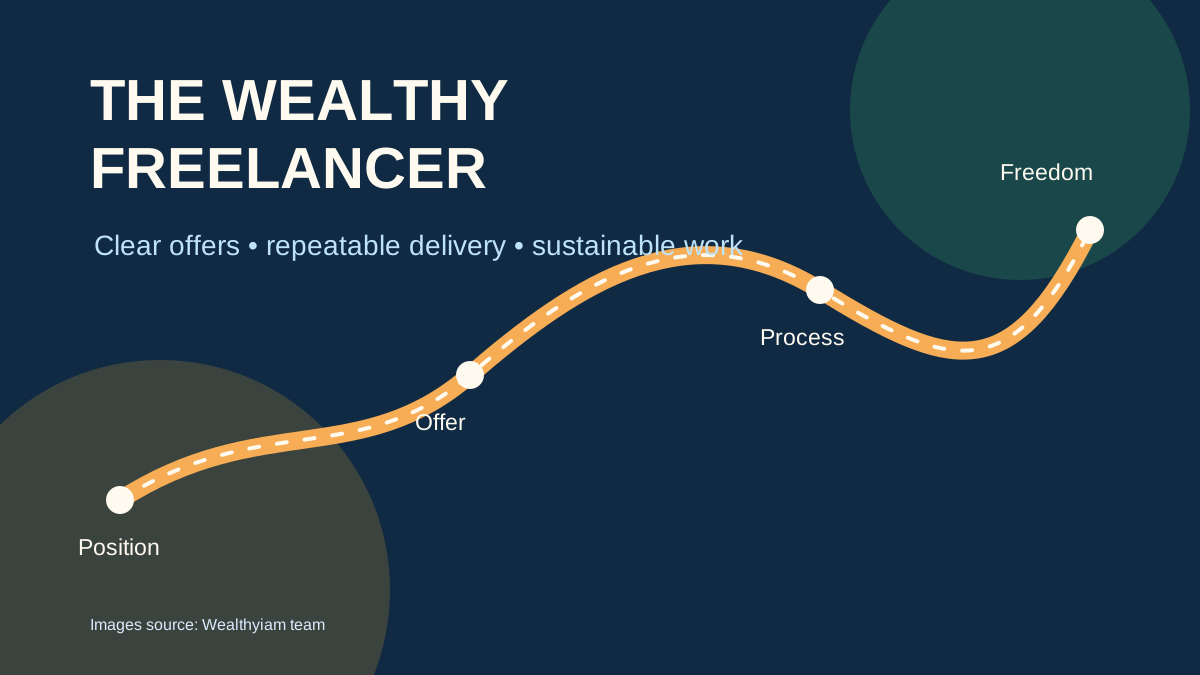
The Wealthy Freelancer: 12 Secrets to a Great Income and an Enviable Lifestyle by Steve Slaunwhite, Ed Gandia, and Pete Savage is aimed at independent professionals who want to approach freelancing as a business. The practical themes include positioning, client acquisition, pricing, repeatable delivery, and lifestyle design. The book offers guidance, not a guarantee; its ideas still need to be adapted to your market, obligations, experience, and tolerance for risk.
This article turns those documented themes into seven practical lessons. The headings are an editorial synthesis, not a reproduction of the authors’ exact 12-secret framework.
Who this book is for—and what it cannot do
The book is relevant to independent professionals who sell expertise: writers, designers, developers, consultants, marketers, coaches, analysts, and other service providers. It may also help an employee testing a carefully scoped side business.
Its central problem is familiar: a freelancer can be busy without being profitable. Revenue is money received; profit is what remains after the costs of producing it. A full calendar does not automatically mean healthy profit, predictable demand, or a sustainable life.
The book can help readers ask better questions about value, clients, offers, and operations. It cannot establish what anyone should charge, whether someone should leave employment, or whether a market will support a target income. Current local research—and, when appropriate, professional tax, legal, or financial advice—remains necessary.
Seven practical lessons from The Wealthy Freelancer
1. Position around a problem, not a list of tools
Positioning answers three questions: Who do you help, what problem do you address, and why might someone choose you?
“I do marketing” is broad. “I help independent clinics turn confusing service pages into clearer patient education” is easier for a potential client to evaluate. A narrow position does not have to be permanent; it gives you a useful starting point for discovering where your experience matters.
Try this: Write one sentence naming a client group, a costly or frustrating problem, and the service you can responsibly provide. Test the sentence in conversations before spending heavily on branding.
2. Make the offer easier to evaluate
A service is easier to buy when the buyer understands the starting point, scope, deliverable, timeline, and next decision. That does not require a rigid package for every situation. It does require removing avoidable uncertainty.
For example, a freelance analyst might offer a fixed-scope review of a small company’s customer-retention dashboard, followed by a discussion of the findings. This is a hypothetical illustration, not a forecast or pricing recommendation.
Try this: Create a one-page offer with five fields: the problem, the outcome you can influence, what is included, what is excluded, and what the client must provide. Ask three suitable prospects what remains unclear.
3. Treat client acquisition as a process, not an emergency
A freelancer who markets only when cash is low gives every quiet month too much power. A simple acquisition process might include a weekly block for follow-up, useful publishing, referral conversations, and contact with qualified prospects.
The aim is not to pressure people. It is to make relationship-building consistent enough that one rejection does not become a crisis.
Try this: Track conversations, proposals, decisions, and reasons for a “no.” Use the record to learn which clients and offers fit—not as a guaranteed sales forecast.
4. Price for all the work required, not only the visible hour
An hour of client-facing work can hide preparation, coordination, revisions, software, insurance, taxes, unpaid sales time, and recovery time. Pricing is a business decision with market constraints, not a moral judgment about personal worth.
A project price should account for scope, costs, capacity, and uncertainty. It should not rely on invented return-on-investment claims. If the client’s business result is uncertain, say so.
Try this: For your next proposal, estimate delivery time, non-delivery time, direct costs, overhead, and a reasonable uncertainty buffer. Compare the result with real market feedback. If the economics do not work, adjust the scope, audience, process, or business model rather than quietly accepting unsustainable work.
5. Build repeatable delivery before chasing more volume
A repeatable system is a documented way to perform recurring work with fewer avoidable errors. It might include an intake form, project checklist, standard questions, file-naming rules, review points, and a closeout message.
Creative and advisory work will not be identical every time. The goal is to preserve the parts that should not need to be reinvented.
Try this: After a project, record what the client had to explain twice, what delayed delivery, and what quality check caught a problem. Turn one recurring issue into a checklist item.
6. Prefer fit and trust over every available client
A client can look profitable on paper and still be a poor fit if expectations, authority, communication, or ethics are misaligned. Income is useful only when the way it is earned remains workable.
A basic fit screen might ask whether you can speak with the decision-maker, whether the timeline is realistic, whether there is room for an honest budget discussion, and whether the client respects agreed scope. These questions reduce uncertainty; they do not guarantee a good engagement.
Be careful not to call every boundary “premium positioning.” A boundary should protect quality, clarity, or capacity—not merely create an inflated image.
7. Treat lifestyle as a design constraint, not a postponed reward
The book’s subtitle connects income with an “enviable lifestyle,” but that phrase means different things to different people. One freelancer may value schedule control; another may value stable benefits, fewer clients, geographic flexibility, or more family time. More revenue can also bring more responsibility and stress.
Try this: Define a minimum viable workweek: preferred projects, sustainable hours, recovery time, and the cash reserve you are working toward. Protect sleep and health; a productivity routine is not a substitute for rest or medical care.
A cautious 30-day freelance improvement experiment
The following experiment is a Wealthy I AM application, not a quoted or guaranteed method from the book.
- Week 1—describe: Speak with three people who resemble your intended client. Ask what they do now, where the process breaks, and how they evaluate outside help. Listen before pitching.
- Week 2—package: Draft one narrowly scoped offer. State what is included, excluded, delivered, and dependent on the client. Ask a peer to identify ambiguity.
- Week 3—test: Share the offer with a small number of relevant contacts. Record questions and objections without treating interest as a sale.
- Week 4—review: Compare the time spent on delivery, sales, administration, and recovery. Decide whether to refine the offer, change the audience, improve your proof, or stop.
The useful output is not a promised income number. It is a clearer service description, better information about demand, and evidence about whether the work fits your constraints.
Common mistakes to avoid
- Confusing revenue with profit: Account for costs, taxes, unpaid work, and reserves.
- Copying another freelancer’s niche: Their positioning may depend on reputation, referrals, and timing you do not share.
- Using testimonials as guarantees: A past client’s experience provides context, not a promise of your result.
- Underpricing to win every conversation: Low prices can attract mismatched work and leave too little room for quality or recovery.
- Scaling before documenting: More leads cannot fix a delivery process that repeatedly loses time or trust.
- Leaving employment on a slogan: Consider runway, benefits, dependents, contracts, and local obligations.
- Treating lifestyle as the result of hustle: A business can grow revenue while shrinking lived freedom.
Frequently asked questions
Is The Wealthy Freelancer suitable for a beginner?
It can be a useful starting point for thinking about positioning, clients, pricing, systems, and lifestyle together. Beginners should validate ideas through current market conversations and learn the tax, contract, and compliance rules that apply to them.
Does the book guarantee a high freelance income?
No. Income depends on skill, demand, competition, pricing, execution, economic conditions, and factors outside a freelancer’s control. The book offers guidance; it cannot guarantee a result.
Should freelancers charge by the hour or by the project?
Neither is universally correct. Choose a structure that makes scope, risk, revisions, and payment terms understandable. Project fees can suit defined deliverables; hourly billing can suit exploratory work. Put the arrangement in writing.
What is the most practical first step?
Describe one client problem you can address, then speak with three plausible clients before investing substantially in a website, course, or advertising. Listening is not proof of demand, but it can reveal unclear assumptions at relatively low cost.
A grounded next step
Write a five-field offer: client, problem, deliverable, boundaries, and next step. Test it in one real conversation. If the problem is vague, the buyer is wrong, or the economics do not work, that is useful information—not failure.
The Wealthy Freelancer is best read as an invitation to make freelance work more intentional. Its ideas may help a reader build a clearer service business, but durable wealth still requires judgment about saving, risk, taxes, investing, health, and personal priorities. This article provides general education, not individualized financial, legal, or tax advice.
Sources and further reading
- Open Library work record for The Wealthy Freelancer — bibliographic identity, subjects, and cover association.
- Retail listing for The Wealthy Freelancer: 12 Secrets to a Great Income and an Enviable Lifestyle — title and edition reference.
- Cover source: Open Library Covers API, cover ID 8030196. The publisher must confirm reuse rights and attach the verified image as featured media before publication.