Search intent: Readers looking for a practical summary of The Wealthy Spirit by Chellie Campbell, its main ideas about money beliefs and financial confidence, and cautious ways to apply those ideas to everyday wealth-building decisions.
When money knowledge is not the only problem
You can know that saving matters and still avoid opening an account, reviewing a bill, or naming a financial goal. Sometimes the obstacle is not a missing spreadsheet. It is discomfort: fear of making the wrong choice, shame about past decisions, or a belief that money is something other people understand better.
The internal research record describes Chellie Campbell’s The Wealthy Spirit as combining money-management lessons, exercises, and mindset work to examine beliefs about money, build financial confidence, and support deliberate action. Short answer: use practical money information together with a calmer, more honest view of your own beliefs and behavior. The seven lessons below are a Wealthy I AM synthesis of the research description and bibliographic sources, not a claim that Campbell uses this exact numbered structure.
Evidence boundary: The available Open Library work and edition records verify the book’s identity, author, publication record, subject area, and catalog fields. They do not provide the complete text or every exercise, example, or prescription. Where this article moves from the book’s broad premise to a checklist or example, it is labeled as Wealthy I AM application rather than attributed as a verbatim book framework.
This is general education, not individualized financial, tax, legal, or investment advice. Your income, obligations, jurisdiction, debt terms, health, and risk capacity matter.
Who this book summary may help
This summary is for a reader who wants to improve financial confidence, notices emotional avoidance around money, or wants practical habits that are not built on self-criticism. It may also help a household begin a money conversation without treating one person’s past as a character verdict.
The central idea: money behavior has an emotional layer
A financial plan answers questions such as “How much comes in?” and “Where does it go?” The research description of Campbell’s approach also asks what a person believes money means and how those beliefs affect action. That does not make mindset a substitute for arithmetic. It means that a technically sound plan can still fail if the person cannot face it, does not understand it, or feels the plan conflicts with deeply held values.
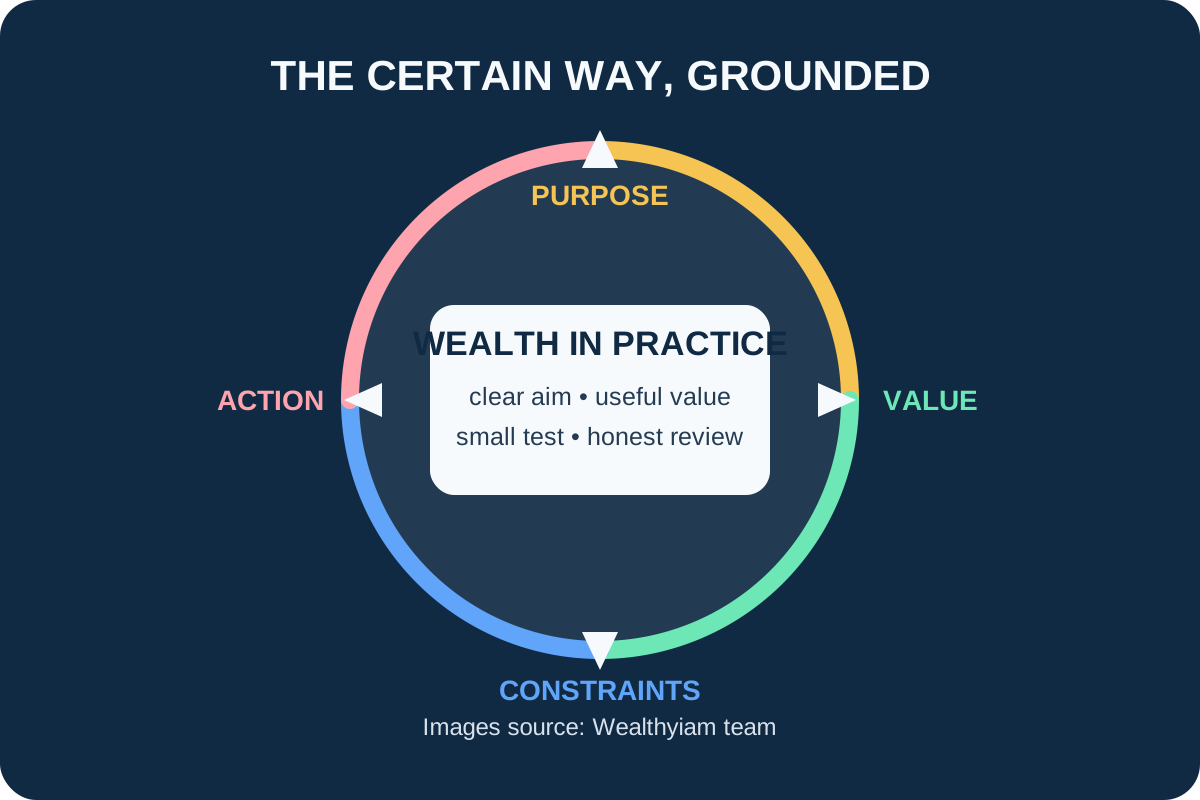
The practical distinction is useful: the book idea is to examine beliefs and build confidence; the Wealthy I AM application is to pair that reflection with one observable financial behavior at a time. Confidence here means greater willingness to look, learn, ask, and act—not certainty that every decision will work out.
Seven practical lessons from The Wealthy Spirit
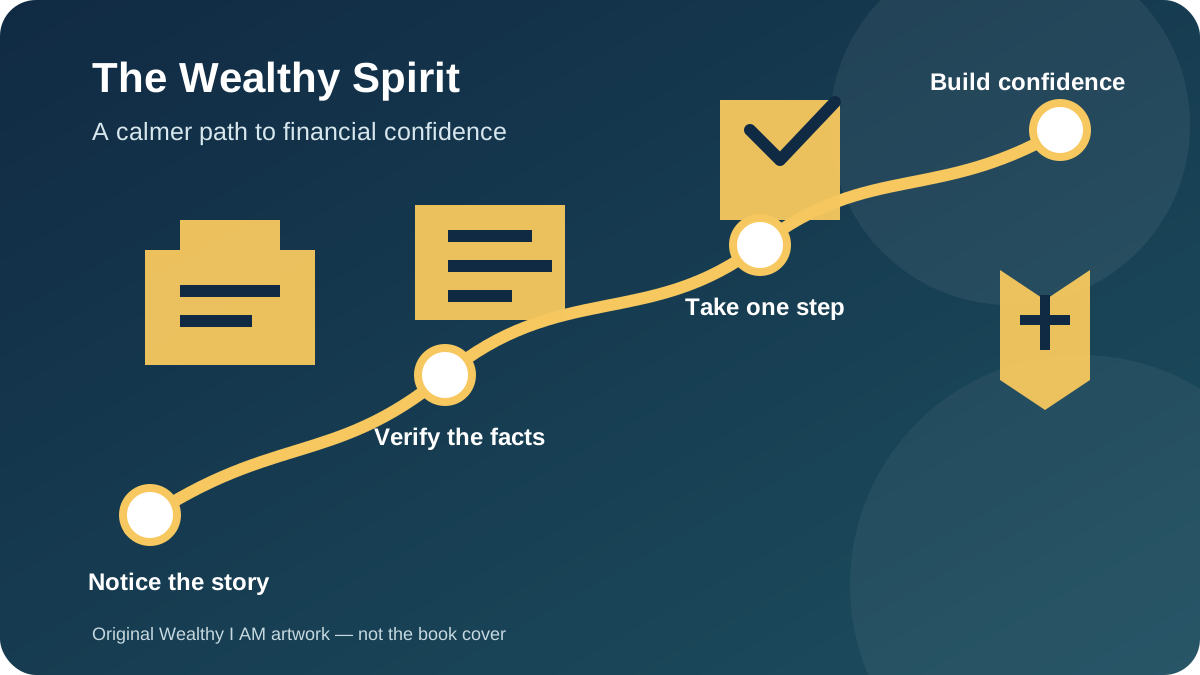
1. Notice the money story you inherited
People often absorb messages about money from family, culture, work, or painful experiences. A belief such as “talking about money is rude” or “wealthy people are selfish” can influence whether someone negotiates, saves, spends, or seeks help.
Try this: write three sentences you remember hearing about money. For each, ask whether it is a fact, a value, a fear, or an outdated rule. Keep values you choose deliberately; question rules that prevent useful action. This exercise does not prove that a belief caused a particular result.
2. Replace shame with accurate information
Shame makes a money problem feel like an identity. Information makes it a situation that can be described. A balance, interest rate, fee, due date, and cash-flow gap are not moral labels; they are facts to verify.
Try this: choose one financial account and record its current balance, fees, rate, and next action from the official statement or provider. If a term is unclear, ask the provider or a qualified professional. Do not guess from a social-media explanation.
3. Build confidence through small, completed actions
A large financial reset can be intimidating. A small action—opening a statement, cancelling an unused service, setting a review date, or asking a precise question—creates evidence that you can participate in your own financial life.
Try this: choose a task that takes 15 minutes or less. Define “done” before starting. Afterward, record what you learned and the next decision it makes possible. The point is practice, not a promise of a particular financial outcome.
4. Give money a job that reflects a chosen priority
A budget is a plan for allocating limited money among obligations, current life, and future goals. It is not a universal moral ranking. A useful plan can include essentials, debt payments, savings, giving, and discretionary spending.
Try this: name one priority for the next month—such as keeping essential bills current, building a reserve, reducing expensive debt, or funding a meaningful activity. Review recent spending and identify one item that supports it and one item whose trade-off you want to reconsider.
5. Separate desire from pressure
Wanting something is not automatically a mistake. The important question is whether the choice is intentional and affordable within the wider plan, or whether urgency and comparison are deciding for you.
Try this before a non-routine purchase: write its purpose, full cost, expected use, recurring commitments, and the goal it may delay. For a hypothetical example, someone considering a subscription could total twelve months of charges, check cancellation terms, and compare the cost with a named priority. That is a decision process, not a forecast of savings or happiness.
6. Learn enough to ask better questions
Financial confidence does not require pretending to understand every product. It requires knowing what you do not know and asking for the missing information. This is especially important with credit, insurance, investments, taxes, and contracts, where terms and consequences vary.
Try this: before agreeing to a financial product, write five questions: What are the total costs? What can change? What happens if I miss a payment? How easy is it to exit? Which risks am I accepting? Get answers from the relevant provider or a qualified adviser and keep the documents.
7. Make progress visible without turning it into a performance
If progress is measured only by income, possessions, or a final net-worth number, many useful steps disappear. A person can make progress by understanding a bill, reducing a costly balance, improving cash reserves, or having a calmer conversation.
Try this: use a monthly three-line review: one fact learned, one action completed, and one question still open. Add a numerical measure that fits your goal, such as debt balance or accessible savings, but do not treat one month as proof of a permanent trend.
A 30-minute “wealthy spirit” money check-in
Use this original Wealthy I AM workflow once a month or after a major financial change:
- Ground in facts (10 minutes). Gather current statements, balances, due dates, and recurring commitments. Mark anything that needs verification.
- Name the feeling (3 minutes). Write the emotion that appears—avoidance, fear, pride, confusion, or relief—without using it as a verdict.
- Choose one priority (5 minutes). Select the obligation or goal that deserves attention now. Avoid trying to optimize everything at once.
- Pick one reversible step (7 minutes). Examples include scheduling a review, requesting information, adjusting a manageable transfer, or pausing a nonessential commitment if its terms permit.
- Set a follow-up (5 minutes). Record what would count as evidence that the step helped and when you will review it.
If the review reveals debt distress, possible fraud, a tax issue, an investment decision you do not understand, or a legal concern, pause and seek appropriate qualified help. Confidence should increase care, not replace expertise.
Mistakes to avoid
- Treating mindset as magic: reflection does not replace income, math, safeguards, or professional advice.
- Using positive thinking to deny a bill: verify the obligation and its terms instead of hoping discomfort disappears.
- Copying someone else’s money plan: household needs, laws, benefits, debt, and risk tolerance differ.
- Making a dramatic change while emotional: prefer a small, reviewable action when the decision is reversible.
- Confusing a book summary with the complete book: the accessible sources do not establish every chapter or exercise.
- Turning financial confidence into risk-taking: confidence should support questions, diversification where appropriate, and attention to downside—not guarantees.
- Measuring worth by financial outcomes: a difficult result can reflect circumstances and uncertainty; review the decision process as well as the result.
Frequently asked questions
What is The Wealthy Spirit about?
The internal research record describes a combination of money-management lessons, exercises, and mindset work focused on money beliefs, financial confidence, and deliberate action. Open Library verifies the book’s identity and bibliographic details, but its live work page does not provide the complete text.
Is this a budgeting book or a mindset book?
The research record supports both practical money-management and mindset elements. The useful application is to pair reflection about beliefs with concrete review of spending, obligations, saving, and decisions rather than choosing one side.
How can I become more confident with money?
Start with verified information about one account or obligation, ask one precise question, and complete one small action. Confidence is better treated as a skill developed through informed practice than as a feeling you must wait for.
Does a wealthy mindset guarantee wealth?
No. Financial outcomes depend on many factors, including income, costs, debt, investment risk, taxes, health, housing, and unexpected events. No book or exercise guarantees wealth.
What if money conversations trigger conflict or shame?
Use neutral facts, take breaks, and avoid turning the conversation into blame. If conflict involves safety, coercion, or serious distress, seek appropriate support. A financial counselor or other qualified professional may help with complicated circumstances.
A low-risk next step
Do not redesign your entire financial life tonight. Open one current statement, write down one fact you had been avoiding, and choose one question or reversible action. Then schedule a review. That small sequence honors the book’s broad connection between beliefs, confidence, and deliberate financial behavior without pretending that confidence solves every money problem.
Conclusion
The Wealthy Spirit offers a useful lens for readers who understand that money decisions are partly practical and partly emotional. Its research-supported premise connects money management with beliefs, exercises, confidence, and deliberate action. The Wealthy I AM application is modest: name the story, verify the facts, choose one priority, and practice one informed step.
CTA: What money belief makes action harder for you? Write it down, label it as fact, value, fear, or inherited rule, and verify one financial fact this week.
Sources / Further reading
- Open Library work record: The Wealthy Spirit — bibliographic identity and catalog description.
- Open Library edition record: The Wealthy Spirit — edition-level identity and publication record.
- Open Library Covers API image — image provenance; reuse rights must be checked before publication.