The reader problem: a property can look profitable before the numbers are clear
Real estate investing is often presented as a simple path: find a property, collect rent, and wait. The harder decision is whether a deal can support its costs, financing, management demands, and downside risk before you commit capital.
The short answer: The ABC’s of Real Estate Investing: The Secrets of Finding Hidden Profits Most Investors Miss by Ken McElroy is a real-estate investing handbook whose catalog record identifies subjects including real-estate investment and management. Its listed contents include finding opportunities, due diligence, making sense of the numbers, ownership, and selling. The practical Wealthy I AM takeaway is not “buy property.” It is to build a repeatable screening process that can reject weak deals early.
This article is a cautious Wealthy I AM application, not a complete chapter-by-chapter summary. The available Open Library record confirms the book’s identity, subject, edition, and table of contents, but it has no full description and cannot establish every example, calculation, or prescription in the text. The seven lessons below are editorial synthesis—not a verified exact numbered framework from the book.
What does The ABC’s of Real Estate Investing help readers think about?
The catalog record places the book in real-estate investment and management and lists sections on research, due diligence, ownership, and selling. A property is not just a purchase price. It is a small operating system involving tenants, maintenance, insurance, taxes, financing, vacancies, compliance, and time.
For readers seeking a summary, the practical thesis is: evaluate the property’s operating reality before allowing an attractive story about appreciation or hidden profit to make the decision for you. A deal may deserve further research, but no screening method removes uncertainty or guarantees income.
Who may benefit from this book—and who should be cautious?
It may help readers who want an introduction to rental-property cash flow, the difference between potential and operating evidence, financing and management risks, and due diligence before an offer. Caution is appropriate for anyone treating real estate as passive by default, relying on a single projection, using borrowed money they cannot comfortably service, or skipping local legal, tax, insurance, inspection, and lending advice.
Real estate is illiquid: selling may take time and costs, and a property can lose value or produce less cash than expected.
Seven practical lessons for screening a real-estate deal
These are Wealthy I AM’s synthesis, not the book’s verified exact numbered framework.
1. Start with the property’s economic job
Before asking whether a property will appreciate, state what it is supposed to do: current income, long-term ownership, business use, diversification, or a possible improvement project. Each purpose calls for different evidence and tolerance for uncertainty.
Cash flow is money left after operating income and expenses are accounted for, before or after financing depending on the calculation. Never compare deals until you know which definition each projection uses. Write one sentence describing the property’s job, then list the evidence that would show it is performing that job.
2. Separate observed income from projected income
A listing may contain current rents, estimated rents, or a seller’s estimate of what could be earned after improvements. Those are not interchangeable. Ask which figures are supported by leases, payment records, market research, invoices, or inspection findings.
Label each line verified, reported but unverified, or hypothetical. If a spreadsheet says rent will rise after renovation, do not treat the higher rent as income until demand, comparable properties, vacancy, renovation cost, timing, and applicable rent rules have been researched. This is a hypothetical illustration, not a forecast.
3. Count the costs that make ownership real
A serious screen should ask about property taxes, insurance, owner-paid utilities, repairs, maintenance, management, vacancy, leasing, professional services, financing, and planned capital expenses. Categories vary by property and jurisdiction.
A capital expense is a larger, less-frequent cost that preserves or improves an asset, such as a major roof or heating replacement. It should not disappear because it is irregular. Create a one-page operating budget with a notes column beside every assumption, and mark what needs a quote, document, inspection, or local professional review.
4. Treat financing as a risk amplifier, not just a return tool
Borrowing can let an investor control a larger asset with less initial capital, but it also creates required payments. If income falls, the payment does not automatically fall with it. Interest rates, refinancing conditions, reserves, lender covenants, and personal guarantees can materially change the risk.
Leverage means using borrowed money alongside your own capital. It can increase gains in a favorable outcome and increase losses or financial pressure in an unfavorable one; it is not free upside. Model a downside case with lower occupancy, a major repair, slower leasing, or higher financing cost. The point is not to predict the future, but to see whether the plan remains survivable if an assumption is wrong.
5. Analyze the manager’s work, even if you delegate it
Property management does not vanish when outsourced. Someone must select and supervise a manager, approve repairs, monitor vacancies, communicate with tenants, review statements, and respond to emergencies. Fees may be visible; owner time and oversight are often not.
List the recurring decisions required each month and identify who will make them. Request a sample management agreement, define approval limits, and check processes for maintenance, tenant screening, deposits, records, and complaints. Local law governs many matters, so use qualified local advice where needed.
6. Test improvement opportunities instead of assuming they are profits
The phrase hidden profits can describe a real operational opportunity, but it can also encourage overconfidence. A possible improvement is not profit until its cost, timing, demand, execution, and risk are tested.
For each proposal, write what changes; what it costs including delays and professional fees; what evidence supports the expected benefit; and what happens if the benefit is smaller, later, or absent. This keeps the improvement thesis separate from current performance and makes it easier to walk away when the upside depends on too many unverified steps.
7. Keep the decision reversible until commitment is unavoidable
Research, inspection, document review, and a written offer with appropriate conditions can preserve options. A rushed, nonrefundable commitment can turn an information gap into an expensive problem. Contract protections vary, so obtain appropriate local legal and professional advice.
A due-diligence period is time allowed to investigate a proposed purchase before a specified commitment becomes binding, subject to the contract and local law. It is not a substitute for careful advice, and its protections differ by transaction. Create a stop list: missing leases, unclear title, unexplained expenses, inadequate insurance, an inspection issue, financing dependent on a best-case appraisal, or a return that works only if every assumption is favorable.
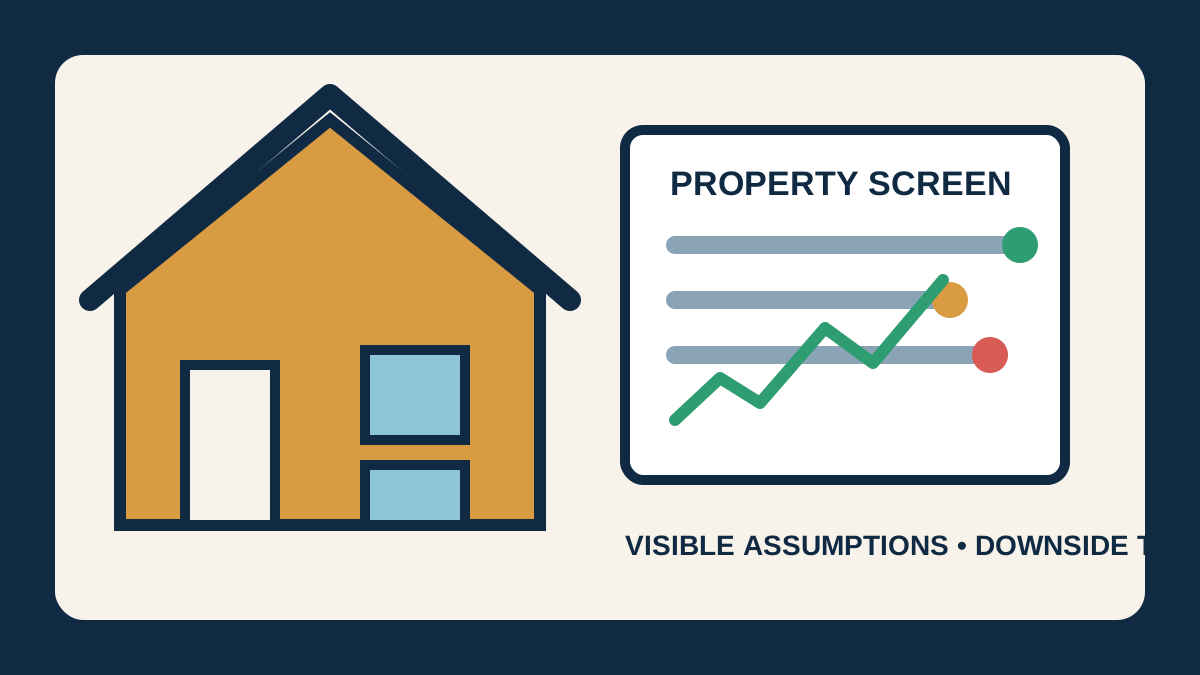
A 30-minute first-pass property screen
This is an original Wealthy I AM workflow, not a checklist attributed to McElroy. It decides whether a deal deserves deeper research—not whether it should be purchased.
Minutes 1–5: define the decision
Write the property type, intended use, investment horizon, available capital, constraints, and the time you can realistically give to management. Do not hide personal liquidity needs from the analysis.
Minutes 6–15: build an operating view
Record asking price, documented income, major operating expenses, vacancy information, financing assumptions, and known capital needs. Put a question mark beside every figure not supported by a document or defensible local comparison.
Minutes 16–22: test a base case and downside case
The base case is your best-supported scenario, not the most exciting one. The downside case changes material assumptions in a less favorable direction. Label both as scenarios, not forecasts.
Minutes 23–27: identify three largest unknowns
These might include insurance availability, the condition of a major system, the reliability of rent records, or the feasibility of an improvement. Name the next document, inspection, quote, or conversation that could reduce each uncertainty.
Minutes 28–30: make a research decision
Choose: continue due diligence, pause until a question is answered, or reject the opportunity. Reject is a productive result when the evidence does not support the risk.
Mistakes to avoid
- Treating appreciation as the only path to a good outcome.
- Using gross rent as if it were spendable cash flow.
- Omitting vacancy, repairs, management, insurance, taxes, or major replacement costs.
- Treating a seller’s projection as verified operating history.
- Assuming leverage makes a modest deal attractive without testing payment stress.
- Calling a property passive while ignoring owner oversight and legal duties.
- Relying on a generic calculator instead of reviewing local documents and conditions.
- Confusing a scenario with a forecast or a forecast with a guarantee.
Frequently asked questions
Is this book a guarantee for making money in real estate?
No. Its catalog identity and subject matter support a real-estate investment and management focus, but no framework guarantees profit. Suitability depends on the property, financing, market, legal setting, and investor resources.
What is the most important number in a rental-property analysis?
There is no single number for every decision. Income, operating expenses, vacancy, financing, reserves, taxes, insurance, liquidity, and purchase price interact. A number attractive in isolation can mislead when definitions or assumptions differ.
Can beginners use the 30-minute screen?
Yes, as initial triage. It should identify questions, not replace inspections, document review, lender analysis, or qualified advice. Beginners should be especially cautious about borrowing and local requirements they do not understand.
Does cash flow mean the same thing in every listing?
No. Listings and analysts may use different definitions, such as before or after financing, reserves, or taxes. Ask for the calculation and rebuild it from underlying documents where possible.
A cautious next step
Choose one real or sample listing and perform the screen without making an offer. Produce a property description, verified and unverified inputs, one base case, one downside case, three unknowns, and a decision about whether more research is justified. If reliable documents are unavailable, the next step may be to stop—not fill gaps with optimism.
Conclusion: good property analysis begins with the questions you refuse to skip
The catalog record and listed contents point toward the operational side of property wealth: finding, researching, analyzing, managing, owning, and selling opportunities. The strongest Wealthy I AM application is a disciplined screen that separates evidence from assumptions and upside from survivability.
Start with one property, one page of numbers, and one downside case. Treat the result as education, not a purchase signal. Real estate can be useful for some investors, but it also brings concentration, illiquidity, operating obligations, financing risk, and local legal and tax complexity. A careful decision may be to continue researching—or to walk away.
Sources / Further reading
- Open Library work record for The ABC’s of Real Estate Investing by Ken McElroy — bibliographic identity, edition, subjects, and listed contents.
- Open Library cover image, cover ID 7158101 — image source and credit.
- Consumer Financial Protection Bureau: What is a debt-to-income ratio? — general explanation of a lender-used debt measure; local lender requirements vary.
<p>The article is general education, not individualized financial, tax, legal, lending, or investment advice. Local rules and transaction documents should be checked with qualified professionals.</p>